Crafting a Unique Brand Voice That Resonates with Your Audience

Your brand isn't just your logo or your color palette. It's how you sound. Every email, social caption, website headline and customer service message either builds trust with your audience or it erodes it. It tells people what to expect from you and reflects your business as a whole in ways a logo never really can. Developing a clear brand voice and tone is one of the most powerful things you do to make your marketing more consistent, recognizable, and effective.
What Is a Brand's Voice and Tone?
Before we dive into how to develop your own, let's get clear on what we mean when we talk about brand voice and tone, and why you often see the two terms used interchangeably despite their distinct differences.
A brand's voice is its personality expressed through language. It's the consistent, overarching character behind everything your brand communicates. Think of it as a reflection of who your brand is: its values, attitudes, and the impression it leaves on people.
A brand's tone, on the other hand, is how that personality shows up in a specific context. Your voice stays the same, but your tone shifts depending on the situation, just like how you might speak differently at a casual networking event than you might during a client presentation or encounter. They're both fundamentally you, just slightly different tones.
Think of it this way:
"Voice is the music. Tone is the volume."
Your brand's voice is consistent. Your tone adapts.
Why Are Brand Voice and Tone Important?
A well-defined brand voice can do more than just make your marketing sound good. It can also create real, measurable success in your business.
It Builds Recognition
When your messaging is consistent across every touchpoint - your website, Instagram, emails, ads, etc. - people start to recognize you immediately. That recognition then builds familiarity. And familiarity builds trust.
It Attracts the Right Audience
The way you speak is a signal. It tells people who you are and whether you're right for them and what they're looking for. The right voice naturally attracts your ideal customers and gently repels those who aren't the right match (which is actually good, because not everyone is your client).
It Makes Marketing Easier
When your team has a clear set of guidelines for how your brand communicates, creating content becomes faster and more cohesive. There's less guessing and fewer revisions when everyone is working from the same playbook.
It Differentiates You From Competitors
In crowded markets, what you say can matter less than how you say it. Your voice can be a genuine competitive advantage, the thing that makes someone choose you over a competitor that is offering something nearly identical. Plus, that recognition we talked about in our first point here can really help drive this home.
The Difference Between Voice and Tone
Let's dig a little deeper into how voice and tone differ in practice. Understanding this distinction can help you develop your own voice and tone.

To put this in a real world example: If your brand voice is "encouraging, knowledgeable and approachable," your tone on social media might be upbeat and casual while your tone in a billing dispute email may be calm and solution-focused, but with the same underlying warmth and expertise.
How to Establish Your Brand Voice
Define Your Brand Foundation
Your brand's personality and voice should always align with your values. Look at your mission statement and your vision for your business. Use this foundation of your business as a base for your marketing endeavors, and therefore for the tone you want all of your messaging to strike.
Research Your Target Audience
This is such an important component of marketing, and one that has been somewhat overlooked recently in the digital age of AI. At the end of the day, you are still marketing to humans. Analyze your existing clientele or the types of customers you would like to attract through social media, audience research, reviews and even surveys. Determine their interests, their preferred communication and writing styles, and the tone that seems to resonate with them.
Analyze Your Current Voice
Review all of your existing marketing assets, like your website, your email marketing, blogs, social media posts, etc.. Identify the recurring themes, consistent messaging and tone that are already being used and ask yourself if they align with your brand's foundation and what your audience seems to respond to. If they don't, it's time to take a step back and analyze what needs to change.
Define Your Personality
To better define your brand's voice, take some time to define your personality. We like to use a 9-point scale with our clients to help them think more deeply about how they want their brand's communications to be perceived.
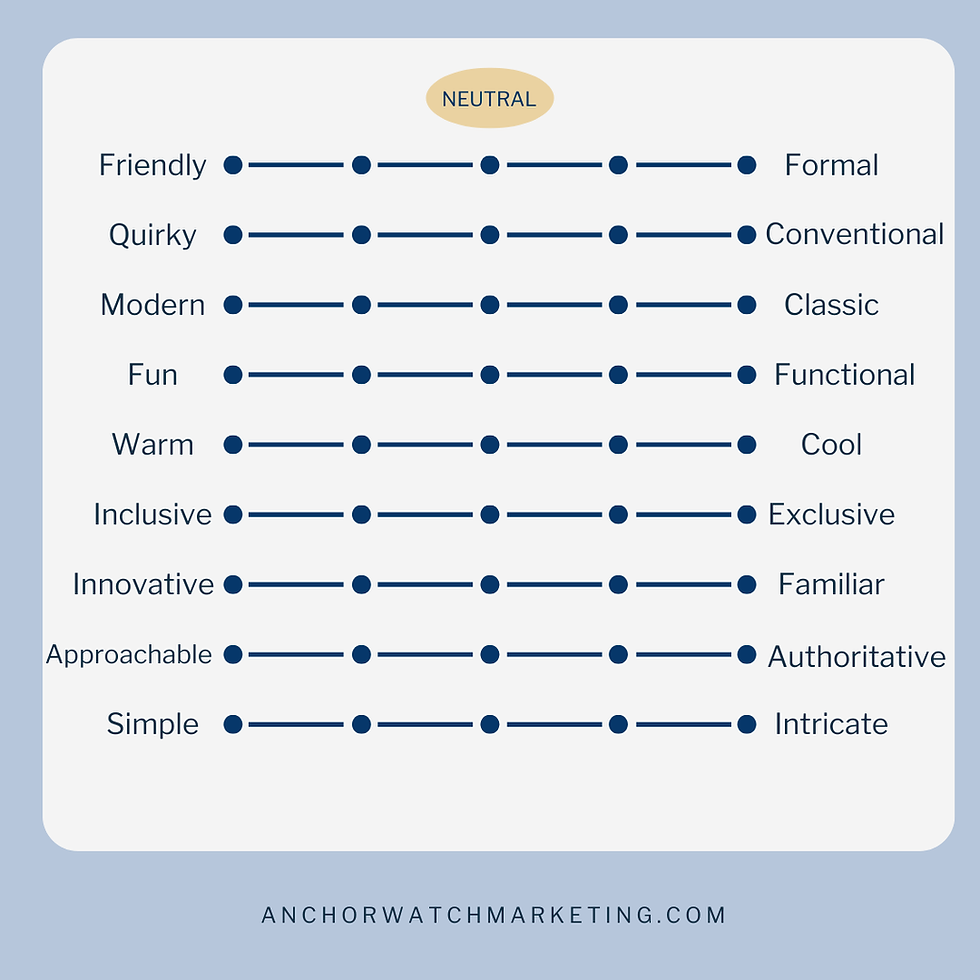
After doing this exercise, it's also really helpful to identify what you are NOT by filling in the blanks of this sentence:
We're _____ but we're not _____.
For example:
We're confident, but we're not arrogant.
We're exclusive, but we're not cliquey.
We're approachable, but we're not unprofessional.
We're classic, but we're not stuffy.
Create a Brand Voice Chart
Looking at the words that came out in step 4, along with your brand's values, identify the top 3 or 4 traits of your brand that feel like the best representation of who you are. And now we get to use them to create a Brand Voice Chart.
A Brand Voice Chart is great way to illustrate how your voice should be used in real-life scenarios. It serves as a reference tool for ensuring your content consistently uses the same voice.
Once you've decided on your primary characteristics, you'll want to enter them into your chart, along with a brief description, do's and don'ts. It's important not to skip the process of defining what each characteristic means to you. In the example below, you'll see a brand that defines itself as 'quirky,' a word that is open for interpretation. So don't be afraid to overexplain.

Document Your Voice Guidelines
Now it's time to pull everything together. Document your brand voice guidelines in one place, so that they may act as a compass, ensuring a unified voice no matter who is representing your business. This document will be critical for onboarding new team members, will serve as a reference whenever you or anyone on the team feels stuck, and is also an AMAZING way to get any AI tools you might be using in your business to sound like you as opposed to every other generic output they provide.
Execute Consistently Across All Channels and Assets
The final step in this process is to execute this unified and consistent voice across all of your channels and assets. Do a review of your website copy to see if it aligns with the tone you are trying to strike. Or ask AI for some help. Paste in samples of your website, your email marketing campaigns, your social posts, everything, and ask for it to score those assets against your defined brand voice and flag inconsistencies so you can update them.
The Bottom Line
Developing the voice of your brand isn't a 'set it and forget it' type of task. As your business grows and evolves, take some time to revisit and refine it. But doing the foundational work now will absolutely pay dividends across every piece of content you create moving forward. When your audience recognizes you from your voice and tone, and not just from your logo, then you know for sure that your voice is working.
At Anchor Watch Marketing, we help businesses define and activate their brand voice across all aspects of their business- from websites and ads, to email campaigns and social media. If you'd like some support in building out your brand voice guidelines, we'd love to talk!
Don't forget to join our FREE Webinar on Thursday, March 5th where we'll be sharing real tips and tricks for leveraging AI to improve your marketing. This won't be another high-promise, low-delivery class full of Chat prompts. We'll be diving into how AI is impacting how people find you online and real steps you can take today to make a difference, including using your brand voice to be better searchable by AI tools!